
AI water usage is one of the most debated numbers in tech, and most of the debate comes down to what gets counted. Every time you send a prompt, a data center does the work, and that building has to shed heat. Often, water carries that heat away.
So how much water does AI use? Per prompt, less than most headlines claim. In total, more than zero, and rising fast in some places. This guide shows the numbers, what they include, and what they leave out. Where we could not trace a figure to its source, we say so.
In this guide:
- What Is AI Water Usage?
- How Much Water Does AI Use?
- AI Image and Video Generation Water Usage
- Is All Data Center Water AI Water?
- What Communities Report
- AI and Water Scarcity
- How to Reduce AI’s Water Footprint
- FAQ
What Is AI Water Usage?
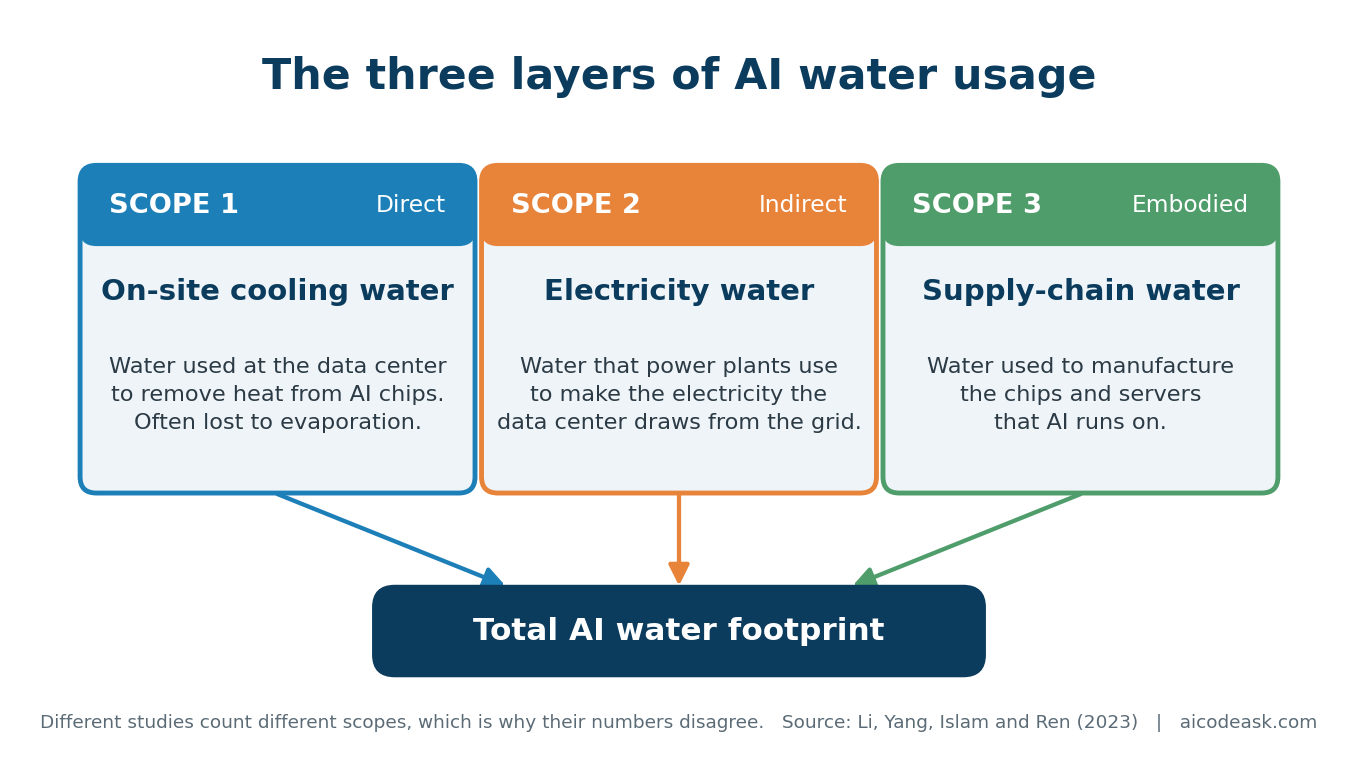
AI water usage is the water tied to building and running AI systems. Researchers split it into three scopes.
Scope 1 is cooling water used on site at the data center. Scope 2 is water that power plants use to generate the electricity. Scope 3 is water used in the supply chain to make chips and servers.
Two more terms matter. Water withdrawal means taking water from a river, lake or aquifer, and some of it goes back. Water consumption means water that does not return to the same source, usually because it evaporated.
Why does AI need water at all? AI chips turn most of their electricity into heat. Many data centers remove it with evaporative cooling, which works like sweat: water evaporates and carries the heat away. Other designs use less water but more electricity.
How Much Water Does AI Use?
Start with one text prompt. Google reported a median of 0.26 milliliters of water for a Gemini text prompt, using May 2025 data. OpenAI’s CEO Sam Altman cited about 0.3 milliliters per ChatGPT query, but he did not publish a method.
Treat both AI water usage numbers with care. They come from the companies, nobody has independently verified them, and Google’s figure counts on-site cooling but not the water used at power plants.
Older research gives larger numbers. A 2023 study estimated about 500 milliliters across roughly 10 to 50 medium-length responses, including electricity-related water. That means 10 to 50 milliliters per response under specific assumptions, not a bottle per prompt.
Why the gap? What the estimate counts, where the data center sits, how old the hardware is, how long the answer runs, and what powers the grid all move the number. Here is how common tasks compare.
| Task | What research shows | Water estimate |
|---|---|---|
| Short text prompt | Median Gemini prompt: 0.26 mL (Google). About 0.3 mL cited by OpenAI’s CEO. | About 0.26 to 0.3 mL, company-reported, mostly cooling |
| Long conversation | Cost grows with the total text processed | No published figure |
| Summarizing a document | Depends on document length and model | No published figure |
| One AI image | About 1,100 joules of GPU energy on one model | No published water figure |
| Editing or regenerating images | Multiply one image by the number of attempts | No published water figure |
| Short AI video (5 seconds) | About 3.4 million joules on one newer model, over 700 times one image | No study measures water per video |
| Longer or higher-resolution video | Energy grows with duration, frames and resolution | No published water figure |
| Online video streaming | No comparable estimate found | Not comparable |
| Non-AI cloud computing | Not reported separately in public water data | Not comparable |
Sources: Google, 2025, The Verge, Li et al., 2023, MIT Technology Review figures in a 2025 scoping review.
Training is a separate part of AI water usage. The same 2023 study estimated that training GPT-3 could directly evaporate about 700,000 liters of fresh water. That happens once per training run, so it should not be charged to every prompt.
AI Image Generation and AI Video Generation Water Usage
Images and video need far more computing than text. In tests reported by MIT Technology Review, one image on Stable Diffusion 3 Medium took about 1,100 joules of GPU energy. A five-second clip on a newer video model took about 3.4 million joules, more than 700 times as much.
Those are energy figures, not water figures. We found no published study that measures water per image or per video. Water depends on that energy plus the cooling system and the power grid, so converting joules into milliliters would mean inventing a number. We won’t.
Is All Data Center Water AI Water?
No. Data centers also run websites, email, streaming, storage and business software. Counting every gallon as AI water usage is the most common mistake in this debate.
The best US data comes from Lawrence Berkeley National Laboratory’s 2024 report, summarized here. It estimated that US data centers consumed about 17 billion gallons directly for cooling in 2023, plus about 211 billion gallons indirectly through the electricity they used. That totals about 228 billion gallons, and direct cooling is only around 7 percent of it.
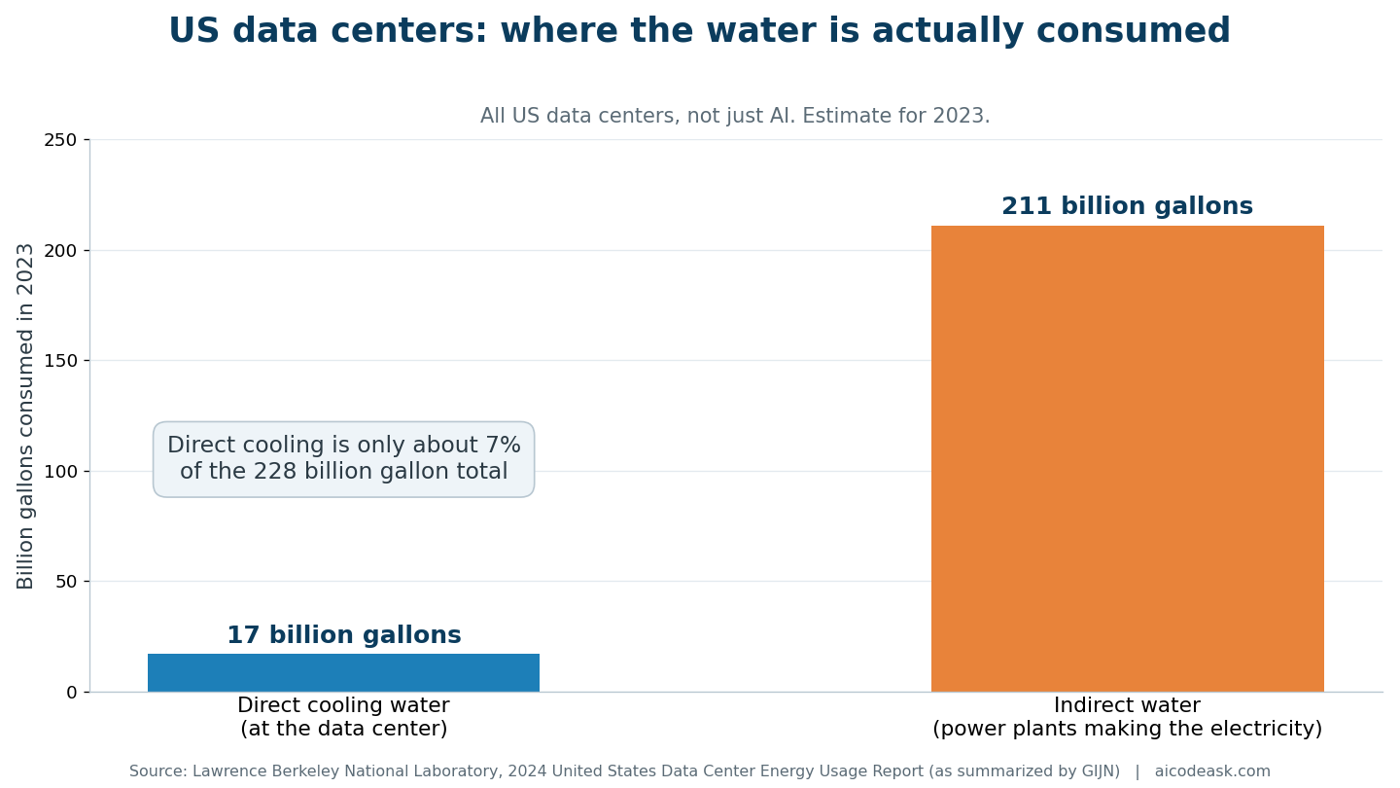
You may have seen a claim that data centers use 223 billion gallons and that AI causes 10 to 15 percent of it. We could not trace that pair of numbers to an original source. The closest verified figure is the 228 billion above, which covers only the US and counts direct plus electricity water.
For AI’s share, the International Energy Agency estimates AI at 15 to 20 percent of data center electricity demand. That is an electricity share, not a measured water share.
A smaller share does not mean a small problem. Berkeley Lab projects that direct cooling water could double or even quadruple by 2028. Single sites matter too: Google reported that its Council Bluffs, Iowa, data center consumed about 1 billion gallons in 2024.
AI Data Center Water Consumption: What Communities Report
National totals hide the local effects of AI water usage. Heavy water demand and water contamination are different problems, so we separate what residents report from what investigators have confirmed.
Water quality in Georgia (alleged, unresolved). Families near Meta’s Stanton Springs data center, on the Newton and Morgan County line, say their well water turned muddy after construction began. Four families sued Meta in 2026, alleging the work disturbed the aquifer. Meta says a groundwater study it commissioned found no impact, and an EPA official said the agency would review the reports. The cause remains unclear, and the complaint concerns construction, not AI cooling water.
Water pressure in Georgia (reported). Reports say a data center campus in Fayetteville used 29 million gallons over about 15 months while nearby residents had low water pressure. Utility officials found two water hookups feeding the campus and now track its meters.
Noise in Virginia (disputed). Neighbors of an Amazon Web Services data center in Prince William County describe a constant hum, and residents report sleep disruption and migraines. They say it exceeds the county’s 60-decibel limit, an Amazon study disputes that, and in 2022 the noise rules exempted air-conditioning units. Loudoun County lists noise among its most persistent data center complaints, notes that standard decibel readings can miss low-frequency tonal sound, and has been drafting new rules since 2024.
Across these cases, communities want open data, and companies rarely publish it.
AI and Water Scarcity: Could the Footprint Grow?
Yes, AI water usage can grow in specific places. Projections differ because they count different things. Rystad Energy estimates data centers used 222 billion liters for cooling worldwide in 2025, and that figure could nearly triple to 644 billion liters by 2030 without adaptive measures. Morgan Stanley’s base case reaches about 1,608 billion liters by 2028, but it adds electricity and chip-making water.
Location matters more than the global total. A 2026 preprint studied ten US sites and found the burden on local water capacity ranged from 0.2 percent to 134 percent of the host community’s capacity. Morgan Stanley also found that more than half of the top data center hubs sit in areas with at least medium water risk.
What about Pakistan? Public data is thin. A June 2026 analysis from the International Bar Association says data centers fall under general industrial water permits, with no duty to report water-use effectiveness. The government plans to allocate 2 GW of grid power to AI data centers and Bitcoin mining. One IPRI policy brief models 6.3 million cubic meters of extra cooling withdrawal per year by 2030, but that is a scenario, not a measurement.
How to Reduce AI’s Water Footprint
No single fix cuts AI water usage everywhere. These six steps work together.
- Measure and publish. Companies should report direct and electricity water separately, by facility, with outside verification.
- Match cooling to climate. Closed-loop and liquid cooling cut evaporation, but low-water designs can use more electricity.
- Choose sites carefully. Run local water assessments, avoid stressed aquifers, and involve nearby residents first.
- Use cleaner power. Solar and wind use far less water than thermal plants.
- Use reclaimed water. Non-potable sources can replace drinking-quality supplies where it is safe.
- Build efficient models. Microsoft improved its water efficiency by about 25 percent and AWS by about 37 percent from 2022 to 2025, yet both still used more water overall.
What Can Developers and Everyday Users Do?
You cannot fix data center cooling from your keyboard, but you can cut waste. Write one clear prompt instead of regenerating five times (AI Prompt Generator) can help you structure it), reuse good results, and pick a smaller model when it does the job.
Developers can cache repeated answers, cap automated loops, and choose providers that publish water data. Still, the biggest decisions belong to companies, utilities and regulators, so there is no reason to feel guilty for using AI.
Frequently Asked Questions
How much water does AI use per prompt?
Company figures put a typical text prompt at about 0.26 to 0.3 milliliters, roughly five drops. Google measured 0.26 mL for a median Gemini prompt, and OpenAI’s CEO cited about 0.3 mL for ChatGPT. Neither figure is independently verified, and older studies that include power-plant water estimate 10 to 50 mL. The real number depends on the model, location, and what you count.
Does one ChatGPT prompt use a bottle of water?
No, not as a general rule. The widely shared bottle claim comes from a 2023 estimate of about 500 milliliters across roughly 10 to 50 medium-length responses, including electricity-related water. That works out to 10 to 50 milliliters per response under specific assumptions. Newer company figures are much lower, though they count less.
Is all data center water used by AI?
No. Data centers also run websites, email, streaming, storage and business software. In 2023, US data centers consumed about 228 billion gallons in total, and only about 17 billion of that was direct cooling water. AI is one growing slice of that total, and estimates of its share are not directly measured.
How much water does an AI image or video use?
Nobody has published a reliable figure yet. Studies measure energy instead: about 1,100 joules of GPU power for one image on one model, and about 3.4 million joules for a five-second video on another. Water depends on that energy, plus the cooling system and the power grid, so we avoid turning it into a made-up number.
Is AI causing water scarcity?
It can add pressure in specific places, especially where data centers cluster in dry regions or share small utilities. Globally, farming uses far more water. A 2026 preprint of ten US sites found local burden ranging from 0.2% to 134% of host capacity, which shows why location matters more than the global total.
Conclusion: Responsible AI, Not Fear of AI
The evidence points to a middle path on AI water usage. One prompt uses a few drops by company figures, yet the sector’s total water use is large, mostly tied to electricity, and likely rising. Cooling-only totals mislead, and the Georgia and Virginia cases show why local transparency matters more than any global headline. Ask one question of every statistic you see: what does it count?
Want more plain-English explainers on AI and tech? Browse the latest guides on aicodeask.com, and share this one with anyone who still believes every prompt costs a bottle of water.
Sources and References
- Li, Yang, Islam and Ren (2023), Making AI Less Thirsty: https://arxiv.org/abs/2304.03271
- Elsworth et al. (2025), Measuring the environmental impact of delivering AI at Google scale: https://arxiv.org/abs/2508.15734
- Google Cloud (August 21, 2025), Measuring the environmental impact of AI inference: https://cloud.google.com/blog/products/infrastructure/measuring-the-environmental-impact-of-ai-inference?hl=en
- Lawrence Berkeley National Laboratory (Shehabi et al., December 2024), 2024 United States Data Center Energy Usage Report (add the primary LBNL link before publishing); summarized by GIJN: https://gijn.org/stories/researching-water-consumption-data-centers/
- The Verge (June 2025), coverage of Sam Altman’s per-query figure: https://www.theverge.com/news/685045/sam-altman-average-chatgpt-energy-water
- MIT Technology Review (2025), Inside the effort to tally AI’s energy appetite: https://www.technologyreview.com/2025/06/03/1117685/inside-the-tedious-effort-to-tally-ais-energy-appetite/amp/
- Scoping review of generative AI footprints (2025), arXiv: https://arxiv.org/pdf/2511.17179
- Akinade et al. (2026), AI Data Centers and the Water Use Feedback Loop (preprint): https://arxiv.org/pdf/2606.21760
- Atlanta Journal-Constitution (September 2026), Georgia families sue Meta: https://www.ajc.com/news/2026/09/georgia-families-sue-meta-accuse-its-data-center-of-tainting-their-water/
- NewsNation, Georgia data center water reports: https://www.newsnationnow.com/us-news/southeast/meta-data-center-georgia-muddy-water/amp/
- Loudoun County, Noise and Air Quality Concerns: https://www.loudoun.gov/6405/Noise-Air-Quality-Concerns
- InsideNoVa (2022), Prince William County noise review: https://www.insidenova.com/headlines/cutting-through-the-noise-prince-william-county-to-review-code/article_e74b5846-2df3-11ed-b2f6-2f08b7eee3ca.html
- AFP report on Rystad Energy estimates: https://kuwaittimes.com/article/49367/business/ai-data-centers-are-less-thirsty-now-tech-giants/
- Morgan Stanley report coverage: https://www.uniindia.com/ai-data-centres-will-drive-massive-annual-water-consumption-by-2028-morgan-stanley-report/business-economy/news/3569718.html
- International Bar Association (June 2026), AI’s water footprint under Pakistan’s legal framework: https://www.ibanet.org/Navigating-AI-implications-for-water-under-Pakistan-legal-and-environmental-framework
- IPRI, AI Data Centers vs. Water Sustainability in Pakistan: https://ipripak.org/?p=26853