
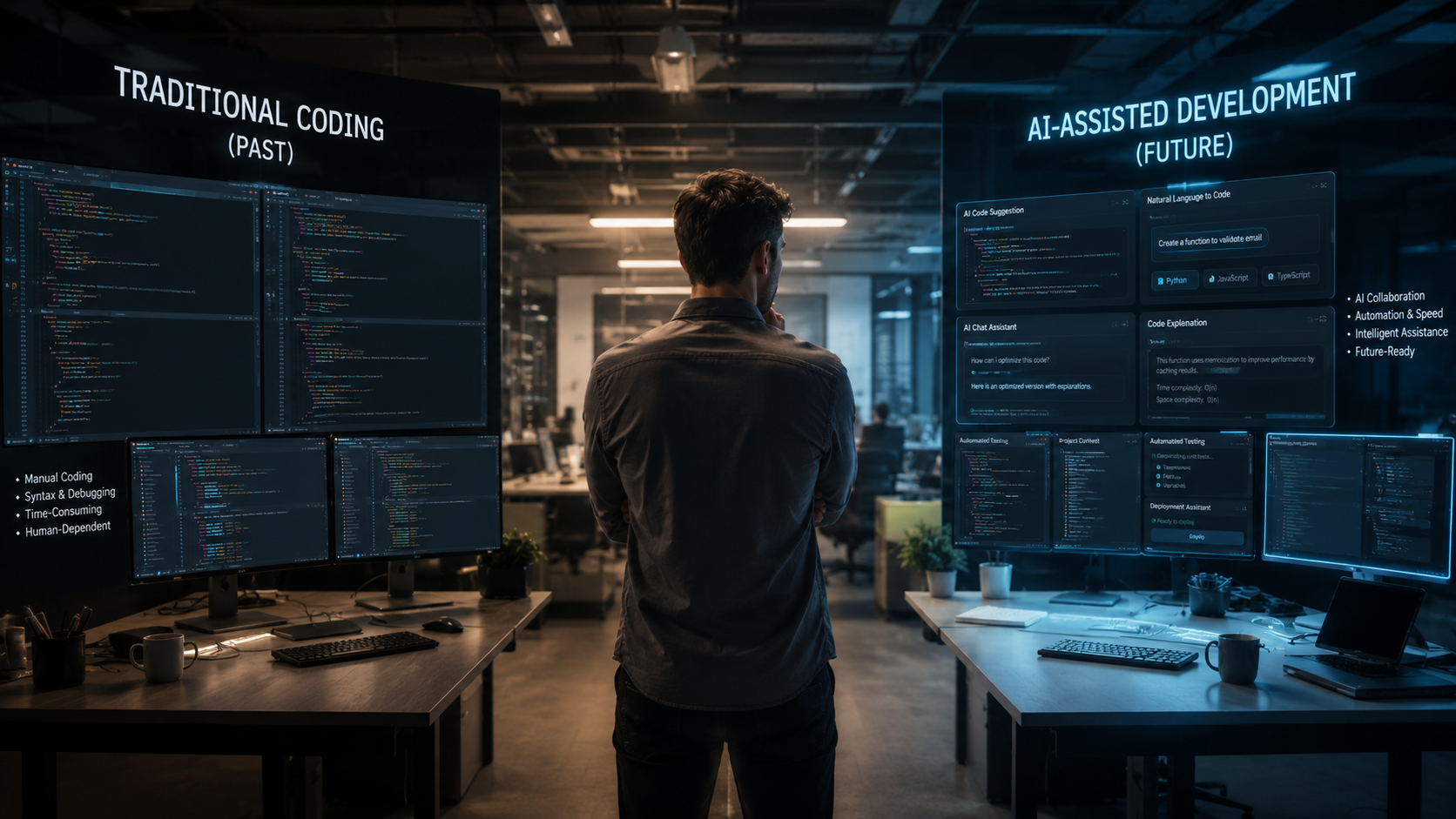
You typed “is coding dead” into Google at 2am.
Maybe you just started learning Python. Maybe you spent months grinding through tutorials. Maybe you are a student who chose computer science and now you are second-guessing everything because of a YouTube video that said AI will replace all programmers by 2026.
Take a breath.
This article will give you the honest, straight answer — no hype, no clickbait, no panic. Just facts and a clear path forward.
Why Everyone Is Saying Coding Is Dead
Let’s be real. The headlines are scary:
- “AI writes code better than most developers.”
- “Junior developer jobs down 67% in 2026”
- “GitHub says 51% of all code commits are now AI-generated.”
These headlines are not fake. They are real. And that is exactly why millions of students, beginners, and even experienced developers are searching “is coding dead 2026” every single day.
The fear makes sense. You see tools like ChatGPT, Claude, and GitHub Copilot writing entire programs in seconds. You see companies like Anthropic and NVIDIA openly saying their engineers use AI to generate most of their code. You hear Jensen Huang from NVIDIA saying “describe software in specifications, not programs.”
It feels like the ground is shifting under your feet.
But here is what those headlines are not telling you.
What the Real Data Actually Shows
Let’s look at numbers — not opinions, not YouTube drama. Real data.
The US Bureau of Labor Statistics (BLS) projects 15–17% job growth for software developers through 2034.
Read that again. Not a decline. Not flat. Growth. 15 to 17 percent growth over the next decade, even with all the AI tools that exist right now.
Here is another number: 87% of developers are now using AI tools in their daily work. That sounds like AI is taking over. But look at it differently — 87% of developers are still working. They are just working with better tools.
Think about what happened when calculators were invented. People feared mathematicians would lose their jobs. Instead, mathematicians stopped doing long division by hand and started solving rocket trajectories, cryptography, and climate models. The calculator did not kill mathematics. It freed mathematicians to do bigger things.
AI is the calculator. Coding is mathematics. The tool changed. The need did not disappear.
What Kind of Coding Is Actually Dying
Here is the honest part that most articles skip because they do not want to upset anyone.
Some coding is dying. Let’s name it clearly:
Copy-paste coding is dying. If your job was writing the same React component over and over, or building basic CRUD apps that follow a template — yes, AI does that faster and cheaper than any human.
Syntax memorization is dying. Spending three hours trying to remember the exact syntax for a Python dictionary comprehension? AI solves that in three seconds. That skill alone is no longer valuable.
Entry-level “prove you can write code” projects are dying. Building a to-do app to show you know JavaScript? In 2026, AI generates one in sixty seconds. That project no longer proves anything.
Bootcamp-style surface knowledge is dying. Six weeks of learning HTML and CSS and calling yourself a developer? The market is brutally honest about this now. Companies are not hiring for surface knowledge anymore.
This is not fun to hear. But it is the truth. And knowing the truth helps you prepare instead of panic.
What Kind of Coding Is Growing Fast
Here is the part that should give you real hope.
AI-assisted engineering is exploding. Developers who know how to direct AI, review its output, catch its mistakes, and build systems around it are more valuable than ever. These developers are not replaced by AI. They are supercharged by it.
System design and architecture is booming. AI can write a function. It cannot design a scalable system that handles a million users. It cannot make the tradeoff decisions that keep a business running. That requires human judgment, experience, and understanding.
AI integration roles are brand new and in demand. Connecting AI models to real products, APIs, and workflows is a skill that barely existed three years ago. Right now there are more open positions than qualified people to fill them.
Debugging and problem-solving are more valuable. When AI generates code and something breaks — and it will break — you need a human who understands the underlying logic to fix it. You cannot debug what you do not understand.
Specialized domain coding is untouched. Medical software, aerospace, embedded systems, cybersecurity — these fields require deep expertise that AI cannot replace because the cost of an AI mistake is too high.
The pattern is clear: coding that requires judgment, creativity, and responsibility is not just surviving — it is thriving.
Should YOU Still Learn Coding in 2026?
Yes. Without hesitation. Here is why.
There is a saying that captures this moment perfectly: “Give a man a tool and he builds one thing. Teach a man to think and he builds anything.”
Learning to code in 2026 is not about memorizing syntax. It is about training your mind to think logically, break problems into steps, and build systems that work. That way of thinking cannot be replaced by AI because AI needs a human who thinks that way to direct it.
If you are a student right now — whether in Pakistan, India, the US, or anywhere in the world — you are actually in the best position possible. You are learning to code alongside AI tools from the beginning. You do not have old habits to unlearn. You can build in days what used to take weeks. The developers who struggle are the ones who refuse to adapt. You do not have that problem.
Think of it this way: the best time to learn cooking was before restaurants existed. The second best time is now — because now you can learn and use the best tools at the same time.
Every skill you build today compounds. The logic you learn in Python today will help you understand AI-generated code tomorrow. The problem-solving you practice now will make you the person companies trust when the AI makes a mistake.
Do not quit. Adapt.
The 3 Skills That Actually Matter Now
If you want to be relevant in 2026 and beyond, focus your energy here:
1. Learn to think in systems, not just syntax
Understand why code works, not just how to type it. Learn about data structures, algorithms, APIs, and databases at a conceptual level. When you understand the why, you can direct AI effectively and catch its errors confidently.
2. Learn to work with AI tools, not against them
Get comfortable with GitHub Copilot, Claude Code, and ChatGPT for coding. Learn prompt engineering — how to give AI the right instructions to get the right output. This is a skill right now with almost zero competition among beginners.
3. Build real things with real problems
Stop building to-do apps. Build something that solves a real problem you have. A tool that helps students, a script that saves you time, a website that serves a real audience. The experience of shipping something real teaches you more than a hundred tutorials — and it is something AI cannot fake on your behalf.
Final Verdict — Is Coding Dead?
No. Coding is not dead.
Coding without thinking is dead. Coding without adapting is dead. Coding as a mechanical skill with no understanding is dead.
But coding as a way of thinking, building, and solving real problems? That has never been more alive.
The developers who will thrive in the next ten years are not the ones who know the most syntax. They are the ones who use AI as a tool, think clearly about systems and problems, and keep building no matter what the headlines say.
You are reading this article because you care enough to ask the right question. That curiosity — that desire to understand rather than panic — is exactly what separates the developers who adapt from the ones who give up.
Keep learning. Keep building. The future belongs to the people who refuse to stop.
Frequently Asked Questions
Is coding dead because of AI in 2026? No. AI has changed how coding works but has not replaced the need for human developers. Routine and repetitive coding tasks are being automated, but problem-solving, system design, and AI-directed development are growing faster than ever.
Will AI replace programmers in 2026? AI will replace programmers who only do repetitive, low-judgment tasks. It will not replace engineers who understand systems, make architectural decisions, and direct AI tools to build real products. The US BLS still projects 15–17% job growth for developers through 2034.
Should I still learn coding in 2026? Absolutely yes. Learning to code teaches you to think logically and solve problems — skills that make you better at directing AI, not skills that AI replaces. Beginners who learn coding alongside AI tools today have a major advantage over developers who learned before AI existed.
Is programming still worth learning as a student? Yes. Programming is one of the most valuable skills a student can build in 2026. The key is to focus on understanding concepts and building real projects rather than memorizing syntax. Combine coding with AI tool skills and you become extremely employable.
What is the future of coding with AI? The future of coding is human-AI collaboration. Developers will use AI to write boilerplate code, suggest solutions, and speed up workflows — while humans provide judgment, direction, creativity, and accountability. The developers who master this collaboration early will lead the industry.
Try Our Free AI Coding Tools
Learning to code and working with AI goes hand in hand. At aicodeask.com we have built free tools that help you work smarter:
- JSON Formatter & Validator — instantly fix JSON errors without searching Stack Overflow
- AI Code Explainer — paste any code and get a plain-English explanation in seconds
- README Generator — generate professional README files for your projects instantly
- Regex Generator — describe what you need in plain English and get the regex automatically
No signup. No install. Instant results — completely free.
👉 Explore all free tools at aicodeask.com/tools
Have a question about coding, AI tools, or career advice? Drop it in the comments below.